
So you can follow your baby’s growth, we’ll tell you the average weight and length for the given week in his development.
In this article:
~ Lengths are measured from crown to rump (sitting height) until full term. Crown to heel measurements are used at full-term. Measurements for “weeks a to b” are averages.
~ Pregnancy begins the first day of your last period.
~ “Weeks” are measured from the first day of your last period.
~ A “full-term baby” is a baby born at 40 weeks of pregnancy.
~ A baby is “born too soon” or “preterm” if he is born after 20 weeks and before 37 weeks of pregnancy.
~ A baby is “too small” or has “a low birth weight” if he weighs less than 5 1/2 pounds at birth or is too small for his gestational age – no matter when he is born.
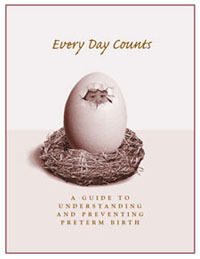
Every Day Counts, A Guide to Understanding and Preventing Preterm Birth
You’re going to have a baby! Like most expectant mothers, you may be having mixed feelings. You may feel both excited and afraid. This is especially true if you have risk factors for having a preterm (premature) baby. It may also be true if you have no risk factors but are having symptoms of preterm labor or more than a normal amount of contractions. If you find yourself in either of these situations, this article was written for you. It will explain:
~what preterm birth is and why you should try to prevent it
~risk factors for preterm birth
~how to prevent or delay preterm birth
Each week that preterm birth is delayed or prevented gives your baby valuable time to grow and mature. That time will increase his chances of being born healthy and can decrease the problems a preterm birth can bring. Following your doctor’s instructions and the guidelines in this article may help you delay or prevent a preterm birth.
This article tells about the risk factors associated with preterm birth and what you can do to help carry your baby to full term. This article is not intended to replace the advice of your perinatologist, ob/gyn, or any member of your health care team.
[pullquote right]Read all you can about pregnancy. The more you know, the better and more amazing the experience.There is a lot of information in this article. Use the Table of Contents below to find information you need to know or want to learn right away. Then take your time reading the rest. There are many questions that we suggest you ask your doctor about your pregnancy. Print them out and take them with you to visit your doctor.
Reading this article may also bring up questions of your own. If so, write them down, then ask your doctor or nurse; write down their answers so you can refer to them later. Read all you can about pregnancy. The more you know, the better and more amazing the experience.
Table of Contents
CONGRATULATIONS!
Taking Part in Your Prenatal Healthcare
THE IMPORTANCE OF PREVENTING PRETERM BIRTH
• What Is Preterm Birth?
• Why Prevent Preterm Birth?
• Who Is At Risk for Preterm Birth?
• But I’m Not At Risk!
RISK FACTORS FOR PRETERM BIRTH
• Risk Factors for Preterm Birth
• Race and Ethnic Background
• Age
• Size and Makeup of Household
• Gynecological, Obstetrical, and Health Factors
• Current Pregnancy
• Preterm Birth Can’t Always Be Prevented
THE EFFECTS OF STRESS
• Stress
• Identifying Stress and Its Effects
• Stress at Work
• Supermom
• Ways to Reduce Stress
THE EFFECTS OF PHYSICAL ACTIVITY
• Physical Activity
• Growth of the Uterus
• The Effects of Standing
• The Effects of Lifting and Carrying
• Limiting Your Physical Activity
GROWING A HEALTHY BABY
• Weight Gain
• The Importance of a Balanced Diet
• Iron Deficiency Anemia
• Folic Acid (Folate)
• Calcium and Phosphorus
• Constipation
• Smoking
• Drugs and Alcohol
• Caffeine
PREVENTING PRETERM BIRTH
• Preventing Preterm Labor and Preterm Birth
• Identifying Activities That Cause Uterine Contractions
• Self-monitoring Contractions
• Kick Counts
• If Problems Arise or If You Go Into Labor
• Signs and Symptoms of Preterm Labor
• When You Call Your Doctor
• If Your Doctor Says “Meet me at the hospital”
• Medical Care at Home
©2000-2017 Media Partners, Inc.
3883 Rogers Bridge Rd, Suite 201 A
Duluth, GA 30096
Expert Advisors:
Jeffrey H. Korotkin, MD. Dr. Korotkin is a perinatologist at Atlanta Perinatal Consultants, Atlanta, GA and specializes in the diagnosis and management of high risk pregnancy.
Bette Rothman, RN, BS, Certified Legal Nurse Consultant. Ms. Rothman is a contributing author of the OB manual “High Risk Clinical Conditions of Pregnancy” and lecturer on patient care for Learning Tree University in California.
Related Booklets from Media Partners, Inc. – Content now available online!
Caring For Yourself After Vaginal Birth
Caring For Yourself After Cesarean Birth
Caring For Your Newborn – Caring for Your Newborn en Español
Resource:The American Congress of Obstetricians and Gynecologist